 how-to
Fast Car Maintenance in Glenshaw: Your 2026 Guide
Table of Contents
- Fast Car Maintenance in Glenshaw: What to Expect at Joe Ball
- The GMC Maintenance Schedule Every Owner Should Follow
- Quick Oil Change and Other Services You Can Get Done Fast
- How to Book a Car Maintenance Appointment Without the Wait
- What to Ask Before You Approve a Car Repair Estimate
- DIY Checks vs. Professional Service: What You Can Handle at Home
- Seasonal Car Maintenance in Glenshaw: Preparing for Pennsylvania Weather
- Conclusion: Keep Your Vehicle Running with Fast, Local Service
- Frequently Asked Questions
Last Updated: October 14, 2026
Fast Car Maintenance in Glenshaw: What to Expect at Joe Ball
Fast car maintenance in Glenshaw starts with knowing what your vehicle needs and when. At Joe Ball, we handle routine maintenance, quick oil changes, tire rotations, and brake inspections for drivers across Glenshaw, Etna, Fox Chapel, and Shaler, all built around one idea: get you back on the road without the all-day wait.
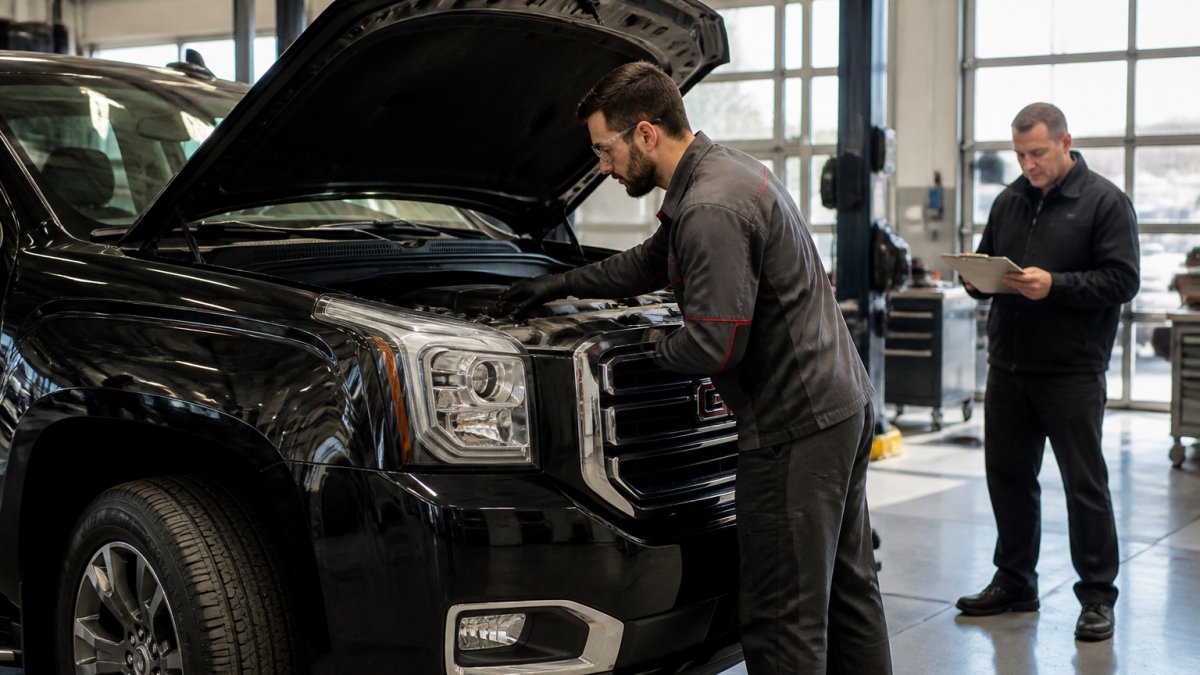
Car maintenance is the scheduled set of inspections, fluid changes, and part replacements that keep a vehicle safe and running properly. Skipping those intervals turns small issues into expensive repairs.
Why Local Drivers Choose Joe Ball for Routine Service
Drivers around Mount Royal Boulevard and Route 8 choose Joe Ball because we stock genuine GM parts and handle routine service in-house, no waiting on an outside supplier.
Our service area covers Glenshaw, Allison Park, Monroeville, Etna, and Gibsonia, so most customers are a short drive away.
We schedule routine maintenance so common jobs get done the same day, keeping slots open for our most frequent services: oil changes, tire rotations, and inspections.
The GMC Maintenance Schedule Every Owner Should Follow
The GMC maintenance schedule is built around mileage intervals, not calendar dates alone. Most GMC vehicles follow a pattern of service every 7,500 miles for oil and filter changes under normal driving, with tire rotations paired to the same visit.
Your owner's manual is the final word for your specific model, whether that is a Yukon, Acadia, Sierra 1500, or Canyon. What follows is the general shape of it.
| Interval | Service | Why It Matters |
|---|---|---|
| Every 7,500 miles | Oil and filter change, tire rotation | Protects the engine, evens tire wear |
| Every 15,000 miles | Cabin and engine air filters, brake inspection | Keeps airflow clean, catches pad wear early |
| Every 30,000 miles | Transmission fluid check, coolant service | Prevents the costliest repairs |
| Every 45,000 miles | Spark plugs, drive belts inspection | Maintains fuel economy and starting |
| Every 60,000 miles | Transmission service, hoses, suspension check | Addresses wear before failure |
Maintenance Intervals by Vehicle Type and Driving Conditions
Driving conditions change the schedule more than most owners expect. Short trips, stop-and-go traffic, towing, and cold starts all count as severe service, which shortens oil change intervals.
- Daily commuters on Route 8: follow the normal interval, usually every 7,500 miles
- Trucks used for towing or hauling: shorten oil changes, often to every 5,000 miles
- Vehicles doing mostly short trips: change oil more often, since the engine rarely reaches full temperature
If your driving falls into more than one category, follow the stricter schedule. It costs less than the repair it prevents.
Quick Oil Change and Other Services You Can Get Done Fast
A quick oil change is the fastest maintenance item on the list and the one that protects your engine most. Most oil and filter services are completed while you wait, especially when you book ahead.
Beyond oil, these are the jobs we can typically turn around quickly:
- Tire rotation and pressure check
- Brake pad inspection
- Battery and charging system test
Transmission service and transmission repair take longer, since fluid must be drained, measured, and refilled correctly. Diagnostics and complex repairs also need more bay time. We tell you upfront which category your job falls into.
If you need a repair estimate before committing, ask at drop-off. We would rather spend five minutes explaining the work than have you approve something you do not understand.
How to Book a Car Maintenance Appointment Without the Wait
Most drivers lose time not in the service bay but in the gaps around it, waiting on a callback, discovering a part is not in stock, or arriving without the information the advisor needs. Booking well means removing those gaps before you arrive.
What actually determines turnaround time
Three variables decide whether a routine job finishes while you wait or stretches into the day:
- Parts availability. An oil filter, cabin filter, or wiper blade for a common GMC model is usually on the shelf. A specific trim-level sensor or body panel may need to be ordered, adding a day or more.
- Bay and lift time. Oil changes, tire rotations, and inspections use a standard lift and finish quickly. Transmission service, diagnostics, and anything requiring the vehicle to be raised and partially disassembled need a bay held for a longer block.
- Diagnostic depth. A stored trouble code can be read in minutes, but confirming the root cause, a wiring fault versus a failed sensor, can take considerably longer. Ask whether the estimate covers diagnosis alone or diagnosis plus repair.
How to prepare so the visit moves
- Book online and choose an early slot when possible. Parts ordered in the morning tend to arrive the same day; late orders often roll to the next.
- Record your current mileage before you arrive. It anchors the service recommendation to your actual interval rather than a guess.
- Bring your owner's manual or service records so the advisor can avoid duplicating work done elsewhere.
- Describe symptoms precisely in the appointment notes, when the noise happens, whether it is cold or warm, whether a light is steady or flashing. Vague notes cost diagnostic time.
- Ask two questions when you confirm: what is the expected turnaround, and is the needed part in stock?
Setting realistic expectations
Same-day completion is realistic for oil and filter changes, tire rotations, brake inspections, battery and charging tests, and filter replacements. Transmission fluid service, warning-light diagnostics, and ordered parts are better planned as a drop-off.
If you need the vehicle back by a specific time, say so when you book rather than when you drop off. A shop that knows your deadline can sequence the work accordingly; one that learns at pickup cannot.
What to Ask Before You Approve a Car Repair Estimate
A car repair estimate should tell you three things: what is wrong, what the fix costs, and whether the work is urgent or can wait.
Questions worth asking every time:
- Is this repair safety-critical or can it be scheduled later?
- Are the parts genuine GM parts or aftermarket equivalents?
- Does the estimate include labor, tax, and shop supplies?
That last question matters. Genuine GM parts come with a manufacturer warranty, while aftermarket parts often carry a shorter or different one.
Ask for the estimate in writing. A verbal number is easy to change later; a written one is easy to compare.
DIY Checks vs. Professional Service: What You Can Handle at Home
Some maintenance belongs in your driveway, and some does not. Knowing the difference saves money without risking your safety.
Reasonable DIY checks:
- Tire pressure and tread depth
- Windshield washer fluid
- Wiper blade replacement
Leave these to certified technicians:
- Oil and filter changes on modern engines with underbody panels
- Transmission service and any transmission repair
- Brake pad and rotor replacement
The line is not about difficulty but consequence. A mis-torqued brake caliper bolt or an overfilled transmission can cause a failure costing far more than the service you skipped.
Seasonal Car Maintenance in Glenshaw: Preparing for Pennsylvania Weather
Seasonal maintenance here is two transitions, into a salt-and-freeze winter and into a humid, high-heat summer. Each stresses different systems and rewards preparation done weeks ahead rather than the morning it turns cold or hot.
Winter: salt, freeze-thaw, and cold starts
Road salt does not just sit on the surface.
Freeze-thaw cycles matter too. Water seeping into small cracks in rubber, CV boots, suspension bushings, wiper blades, expands when it freezes and widens the crack.
Cold mornings also expose a weak battery. A battery that cranks fine at 60°F can struggle at 20°F because cold reduces cranking power while the engine needs more of it.
Before winter, prioritize in this order:
- Battery load test, the most common cold-weather failure point
- Tire tread depth and pressure, cold drops pressure roughly 1 PSI per 10°F of temperature fall
- Antifreeze concentration, verify the mix protects to the expected low temperature
- Brake inspection, salt and moisture attack lines and hardware from underneath
- Wiper blades and washer fluid rated for freezing temperatures
Summer: heat soak, coolant, and A/C load
Heat is the opposite problem with a similar cost. Underhood temperatures climb, coolant systems work harder, and the A/C runs at maximum load precisely when the cooling system has the least margin.
Belts and hoses age faster in heat. A belt that is glazed or cracked, or a hose that is soft or bulging, is a roadside failure waiting for a hot day.
Before summer, prioritize in this order:
- Coolant level and condition
- A/C performance test before the first hot stretch
- Belts and hoses inspection
- Cold tire pressure check
- Spare tire, jack, and lug wrench confirmed usable
How to decide what can wait
Not every seasonal item is urgent. A useful split:
- Safety-critical, do now: brake lines and hoses, tire tread below the wear indicator, a battery that fails a load test, any brake fluid or coolant leak.
- Schedule soon: coolant service, transmission fluid service, spark plugs at their interval.
- Monitor: minor cosmetic corrosion, a slightly slow A/C, wiper blades that still clear the glass.
If you are unsure which category a finding falls into, ask the shop to label it during inspection. A written priority, urgent, soon, or monitor, is more useful than a list of everything that could be done.
Conclusion: Keep Your Vehicle Running with Fast, Local Service
Maintenance only works when it actually happens, and the biggest obstacle for most drivers is time. Joe Ball keeps routine service moving with same-day turnaround on oil changes, tire rotations, and inspections, genuine GM parts stocked on site, and online scheduling that lets you pick your slot without a phone call. Our service area covers Glenshaw and the surrounding communities, so you are never far from a bay.
Frequently Asked Questions
How often should a GMC vehicle be serviced?
Most GMC vehicles follow a maintenance schedule of every 7,500 miles for oil changes and tire rotations, with more comprehensive inspections at 15,000, 30,000, and 60,000 miles. However, if you frequently tow, drive in stop-and-go traffic, or face harsh Pennsylvania winters, you may need service closer to every 5,000 miles. Check your owner's manual for the exact GMC maintenance schedule for your model, or ask the service team at Joe Ball to map it out for you.
Which car maintenance services can usually be completed quickly?
A quick oil change, tire rotation, battery test, and wiper blade replacement are typically done within an hour at Joe Ball. Fluid top-offs and basic vehicle inspections also fall into the fast category. If you book a car maintenance appointment online ahead of time, you skip the line and get in and out faster. More involved work like transmission service or complex diagnostics takes longer, but our team gives you a clear time estimate upfront so you can plan your day.
What should I ask before approving a car repair estimate?
Ask for a written, itemized car repair estimate that separates parts from labor. Confirm whether the parts are genuine GM or aftermarket, and request that any additional work be approved by you before it begins. At Joe Ball, we walk you through every line item and never add surprise charges. If a shop cannot explain why a repair is needed or refuses to put the estimate in writing, that is a red flag.
How can I make a car maintenance appointment go faster?
Book online through Joe Ball's scheduling tool and choose an early morning or mid-week slot when the shop is less busy. Let us know your vehicle's make, model, and mileage when you book so we can prepare the right parts and fluids in advance. Bring your service history if you have it, and mention any specific concerns upfront. That way, the technician can start the moment you arrive.